
First of all, what exactly is a trademark!!?
A trademark in its simplest form is a word, phrase, logo or sound that identifies a business or the products and services offered by such business.
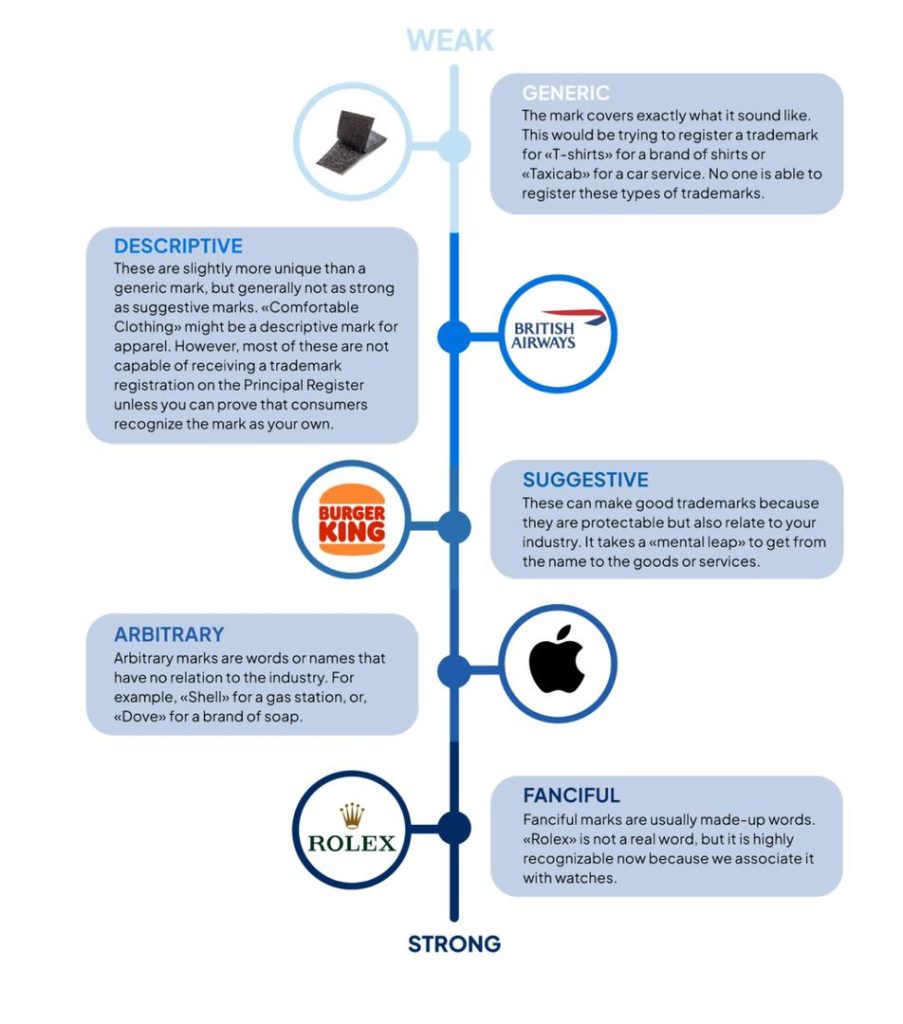
It is very important to know that not all trademarks are created equal. In fact, trademarks come on a sliding scale of protectability.
Here is how that scale works, from the most protectable to the least protectable:
Arbitrary / Fanciful:
Names that have virtually no meaning in relation to the goods and services they’re used in connection with. Arbitrary names are inherently distinctive and tend to offer brand owners the best chance of successfully registering their names.
These are the two strongest trademark types. Arbitrary marks are words or names that have no relation to the industry. For example, “Shell” for a gas station, or, “Bolt” for a ride hailing service.
Fanciful marks are usually made-up words. “Tigo” is not a real word, but it is highly recognizable now because we associate it with telecom. If not for strong advertising, these marks would have no consumer recognition.
Suggestive:
Names that give consumers a hint about the nature of goods or services, but require consumers to use their imagination to reach a conclusion as to the nature of the goods/services.
These can make good trademarks because they are protectable but also relate to your industry. It takes a “mental leap” to get from the name to the goods or services. “Netflix” is a well-known example. The trademark itself is not “Movie Streaming App,” but it does allow the consumer to understand there are movies (i.e. “flix”) available via the internet (i..e “Net”).
Descriptive:
Names that immediately convey the characteristics of the goods or services. To register a descriptive name the law requires evidence that when consumers encounter the name, they are able to identify a single brand as the source of the product/service. These are slightly more unique than a generic mark, but generally not as strong as suggestive marks.
“Comfortable Clothing” might be a descriptive mark for apparel. However, most of these are not capable of receiving a trademark registration, unless you can prove that consumers recognize the mark as your own. “American Airlines” would be an example of a trademark that has achieved this level of recognition. This is not a recommended branding approach because it can be hard to achieve such popularity.
Generic:
Names that are the popular term for describing a class of products or services. These names are so widely used in connection with a general class of items or services, that they are the only (or most common) term for describing a specific product or service. This would be trying to register a trademark for “T-shirts” for a brand of shirts or “Taxicab” for a car service. No one is able to register these types of trademarks.
Even if you have a strong mark, you need to make sure that your mark is unlike anything else in the market. “Bolt” and “Shell” are strong marks due to their unique nature, but if every ride hailing service was named “Bolt,” “BoltRide,” and “Speed Bolt,” then the point of having a fanciful or arbitrary name is null, and the scope of your protection is limited again.
Pingback: MyBlog